
Deciding whether to rent or buy an apartment isn’t always easy. Both options have their benefits, and what works for one person might not work for someone else.
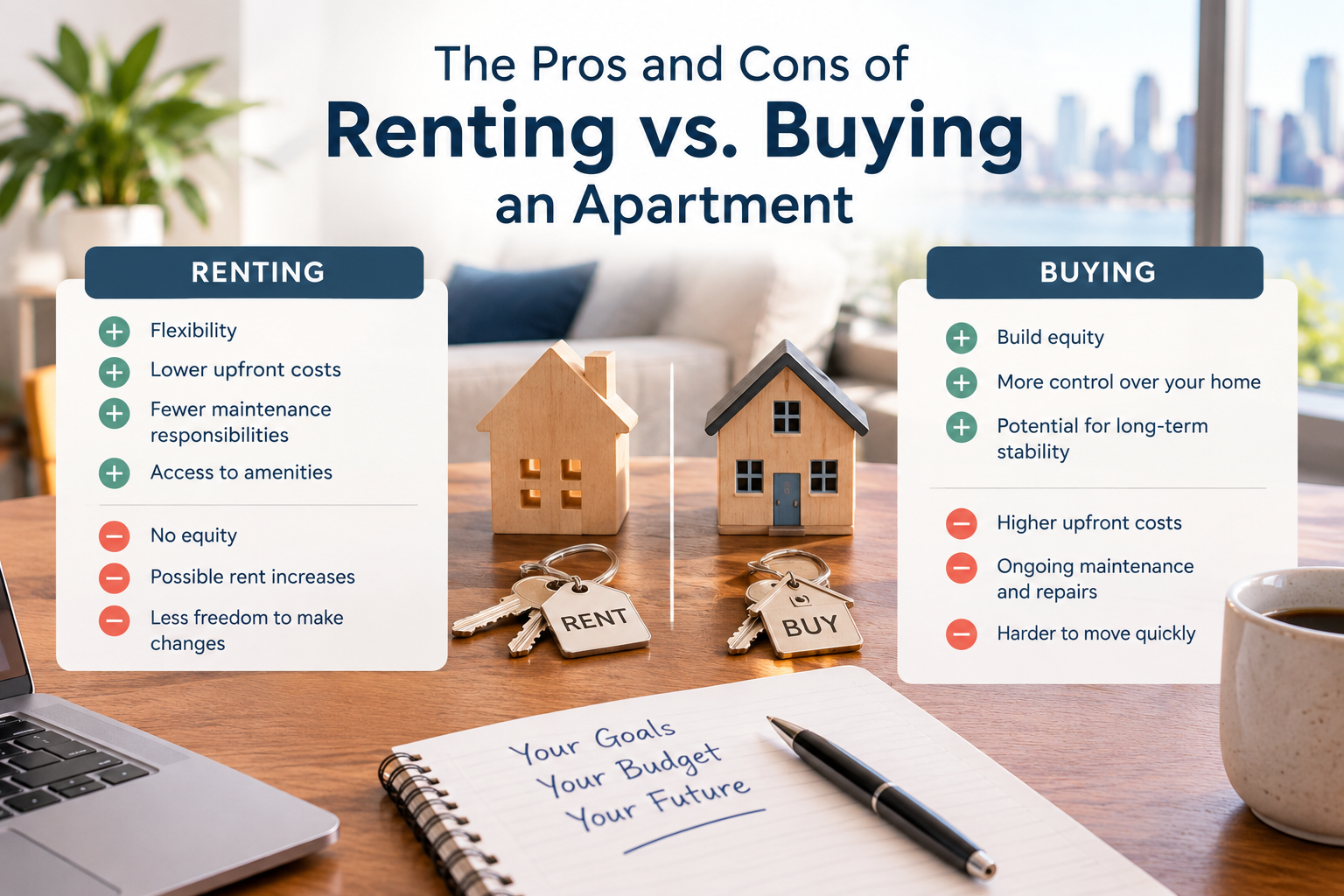
Renting can give you more flexibility, fewer maintenance responsibilities, and lower upfront costs. Buying, on the other hand, gives you the opportunity to build equity and have more control over your home.
The decision to rent apartments or buy also depends on where you live, since rents, home prices and ownership costs vary widely from one market to another.
As a general rule, renting tends to suit shorter stays and flexibility, while buying tends to suit longer stays and long term ownership goals. Neither choice is automatically better, since many people rent and buy apartments at different stages of life, so this guide covers the pros and cons of renting vs. buying and explains how long you need to stay for buying to make financial sense.
Before making a decision, it’s worth looking at your budget, future plans, and how long you expect to stay in one place. Here’s a breakdown of the pros and cons of both options to help you decide what makes the most sense for you.
What Is the Difference Between Renting and Buying an Apartment?
When you rent an apartment, you pay a landlord or property management company for the right to live in a property under a lease agreement. Your lease establishes the rental period, payment terms, responsibilities and other conditions of your tenancy.
When you buy an apartment, you purchase ownership of a residential unit. Depending on the property, this could mean purchasing a condominium or another form of individually owned residence. You may finance the purchase through a mortgage or use your own funds.
Ownership gives you an asset that may appreciate in value, but it also brings financial obligations beyond the purchase price. These can include mortgage interest, property taxes, insurance, maintenance, association fees where applicable and closing costs.
Renting generally involves fewer long term financial commitments. You pay the agreed rent and follow your lease, while major property ownership expenses are usually the owner’s responsibility, subject to the lease and applicable law.
The important distinction between buying and renting apartments is that buying involves acquiring an asset and accepting its ongoing costs. Renting provides the use of a home without requiring you to purchase it.
Many of these points also apply if you are deciding whether to rent apartments or houses, though costs such as association fees apply mainly to condos.
The Pros of Renting an Apartment
1. Lower Upfront Financial Commitment
One of the biggest advantages of renting is that it generally requires less money upfront than buying a property.
Buying a property often means saving for a down payment, covering closing costs, and setting aside money for repairs and other expenses. Renting typically requires your first month’s rent, a security deposit, and any applicable fees.
This difference matters to young professionals, people changing careers and households that want to maintain an emergency fund. Instead of tying a large portion of their savings to a property, renters can retain more flexibility in how they use their money.
2. Greater Flexibility to Change Your Plans
Life rarely follows a perfectly predictable schedule. A new job, a relationship, a growing household or a decision to relocate can change your housing needs.
Renting can make these transitions easier because you are not responsible for selling a property before moving. You still need to respect your lease, notice requirements and any applicable early termination provisions, but you generally have a clearer path to relocating when your lease ends.
This flexibility is especially relevant for professionals whose workplace or commute may change. Your preferred neighborhood today may not be the best fit if your priorities shift.
Renting allows you to evaluate a neighborhood and a building before making a longer term commitment.
3. Fewer Direct Maintenance Responsibilities
Homeownership involves ongoing upkeep. Repairs to appliances, plumbing, heating systems and other parts of a property can require both time and money. Homeowners also need to plan for larger expenses, such as replacing major equipment or addressing unexpected damage.
In a rental apartment, maintenance responsibilities are typically divided between the landlord and the tenant according to the lease and applicable law. Tenants generally report maintenance issues rather than arranging and paying for every major repair themselves.
That can make renting appealing to people with demanding work schedules or those who would rather spend their free time on personal interests than property maintenance.
However, renters should still review the lease carefully. Not every expense or maintenance responsibility automatically falls to the property owner.
4. Access to Modern Amenities Without Owning the Building
Another benefit of renting, especially in newer apartment buildings, is having access to shared amenities without having to maintain them yourself.
For example, many newer apartment buildings offer a fitness center, coworking lounge, rooftop deck, pickleball court, club room and outdoor spaces.
Whether you want to work outside your apartment, exercise, or spend some time outdoors, these shared spaces give you more options without leaving your building.
Of course, not every amenity will matter to everyone. The important thing is finding a building with features you’ll actually use.
The Cons of Renting an Apartment
1. You Do Not Build Home Equity Through Rent Payments
One of the most frequently discussed disadvantages of renting is that monthly rent payments do not give you an ownership stake in the property.
When you buy a home with a mortgage, part of each payment may reduce the principal balance of your loan. Over time, this can increase your equity, assuming the property’s value and your outstanding debt develop favorably.
Rent payments do not work the same way. They pay for the right to occupy the apartment during the rental period.
2. Rent Can Increase Over Time
Renting provides a degree of predictability during the lease term, but it does not guarantee that your housing costs will remain unchanged indefinitely.
One downside of renting is that your monthly payments don’t go toward owning the property. Your rent may also increase when it’s time to renew your lease, and you might need permission before making changes to your apartment
Planning only around the first month’s rent can leave you unprepared for later changes. A more realistic budget accounts for the possibility of moving costs, renewal adjustments and the expense of finding another suitable apartment.
3. Less Freedom to Modify Your Living Space
Renters generally cannot make substantial changes to their apartments without the owner’s permission. Painting walls, replacing fixtures or undertaking renovations may require written approval.
For people who want complete control over their living environment, this can be frustrating. Homeowners typically have more freedom to personalize their property, subject to building rules, permits and other restrictions.
Still, many renters can make a space feel personal through furniture, lighting, artwork and removable décor. A well designed apartment can provide a comfortable home without requiring permanent alterations.
The Pros of Buying an Apartment
1. The Opportunity to Build Equity
Buying gives you the chance to build equity over time. Part of each mortgage payment reduces your loan balance, and if the property’s value rises, your ownership stake can grow even further.
Equity can become an important part of long term financial planning, but buyers should remember that it is not the same as readily available cash. Accessing it may require selling the property, refinancing or using another financial arrangement.
For buyers who expect to stay in the same home for many years, ownership can offer a way to build a long term asset while meeting their housing needs.
2. Greater Control Over Your Home
Homeownership usually provides more freedom to customize your space. Depending on the property and applicable rules, owners may be able to renovate, upgrade fixtures, change finishes and create a layout that better suits their preferences.
This control can be valuable for people who want to establish a long term home, accommodate changing family needs or invest in improvements over time.
Condominium owners should still review association rules, approval requirements and restrictions before planning renovations.
3. Potential Long Term Housing Stability
Buying can provide stability for people who expect to remain in one location for an extended period.
With a fixed rate mortgage, the principal and interest portions of the payment generally remain consistent over the loan term. This can make long term planning easier than relying on successive rental agreements.
However, total ownership costs can still change. Property taxes, insurance premiums, association fees and maintenance expenses may increase. A fixed mortgage payment does not mean every housing expense is fixed.
For households with established careers, sufficient savings and a clear long term plan, ownership may offer a sense of permanence that renting cannot always provide.
4. Possible Tax Advantages
Homeowners who itemize deductions may be able to deduct mortgage interest, within IRS limits. When you sell your primary home, you may also be able to exclude part of the profit from capital gains tax, up to $250,000 for single filers and $500,000 for married couples filing jointly, if you meet the requirements. Tax rules vary by situation and change over time, so consider speaking with a tax professional.
The Cons of Buying an Apartment
1. High Upfront Costs
Buying usually requires far more cash upfront than renting. Most buyers need a down payment, closing costs and a reserve for moving and early repairs. These costs can tie up a large share of your savings before you have spent a day in the home.
2. Ongoing Expenses Beyond the Mortgage
A mortgage payment is only one part of the cost of owning a home.
Owners may also pay property taxes, homeowners insurance, maintenance costs, association fees and special assessments where applicable. Some expenses are predictable, while others arrive unexpectedly.
A property that appears manageable based on its mortgage payment alone may become much more expensive once these costs are included.
Before purchasing, compare the complete monthly and annual cost of ownership with the cost of renting a similar home. Include a realistic allowance for repairs and future maintenance rather than assuming the property will remain trouble free.
3. Less Flexibility if You Need to Move
Selling a property takes time and may involve agent commissions, closing costs, repairs and other transaction expenses. If you need to relocate soon after buying, you may not have enough time for the property’s value to appreciate sufficiently to offset those costs.
Market conditions can also affect how quickly a property sells and how much a buyer is willing to pay.
Home prices can also fall. If you need to sell during a downturn, you may recover less than you paid, especially with a small down payment.
This makes the expected length of your stay an important consideration. If your career or personal plans are uncertain, buying may create a level of commitment that does not fit your current circumstances.
Renting vs. Buying: How Should You Make the Decision?
There is no universal answer to the question of whether to rent apartments or buy. A useful decision begins with your finances, your expected length of stay and your priorities.
| Consideration | Renting | Buying |
| Initial costs | Generally lower | Usually substantially higher |
| Maintenance | Responsibilities depend on the lease and law | Owner is responsible for ownership costs |
| Flexibility | Generally easier to relocate after the lease | Selling can take time and money |
| Equity | Rent does not build property equity | Mortgage principal payments may build equity |
| Customization | Usually subject to landlord approval | Greater control, subject to applicable rules |
| Long term costs | Rent may change at renewal | Taxes, insurance, fees and repairs can change |
| Financial liquidity | More savings may remain available | More money is tied up in the property |
Ask yourself three questions before deciding.
How long do you expect to stay?
If you may relocate within a few years, renting can help you avoid buying and selling costs. If you expect to stay for a longer period, ownership may become more attractive, depending on the local market and financing terms.
Can you afford the complete cost of ownership?
Look beyond the mortgage payment. Include the down payment, closing costs, taxes, insurance, maintenance and an emergency reserve.
What do you need from your home right now?
If you value flexibility, shared amenities and fewer direct maintenance responsibilities, renting may suit your current lifestyle. If you want greater control over a property and are prepared for long term financial responsibility, buying may be worth exploring.
Is Renting an Apartment in Bayonne Right for You?
Bayonne offers an option for people who want to experience waterfront living while remaining connected to the wider Hudson County and New York metropolitan area. The city’s established community character and evolving residential landscape make it worth considering when comparing housing choices.
At AQUA Bayonne, renters can explore studio, one bedroom and two bedroom residences, along with shared amenities designed to support work, recreation and everyday life. The coworking lounge, fitness center and rooftop deck offer different ways to use the building beyond the apartment itself.
For someone who isn’t ready to buy, renting can be a way to enjoy these features while keeping more flexibility for future plans.
The important thing is choosing an apartment and monthly budget that work for you.
Frequently Asked Questions
Q1 – Is it better to rent or buy an apartment financially?
Ans – When it comes to buying vs. renting an apartment, it depends on the purchase price, rent, mortgage terms, ownership expenses, investment alternatives and how long you plan to stay. Compare the total costs of both options rather than looking only at rent and mortgage payments.
Q2 – Is renting an apartment throwing money away?
Ans – No. Rent pays for housing and the flexibility to live in a property without purchasing it. Buying can build equity, but it also involves interest, taxes, maintenance and transaction costs that do not directly create equity.
Q3 – How long should you stay in a home before buying makes sense?
Ans – There is no universal timeline. Buying and selling costs can make ownership less attractive for short stays, while a longer period may provide more time to build equity. Use current local figures and your expected length of stay to assess the break even point.
Q4 – Are rent to own apartments a good alternative?
Ans – Rent to own arrangements vary considerably. Some agreements allow part of the rent to count toward a future purchase, while others provide an option to buy under specific conditions. Review the contract carefully, including fees, purchase terms, deadlines and what happens if you decide not to buy. Consider independent legal advice before signing.
Final Thoughts
The pros and cons of renting vs. buying come down to more than the financial comparison. Buying may support long term ownership goals, while renting can preserve flexibility and reduce direct responsibility for property maintenance.
Before committing to either option, evaluate your savings, career plans, expected length of stay and the full cost of housing. A decision that fits your circumstances today is more useful than following a general rule about when you should become a homeowner.
Ready to explore a modern waterfront apartment that fits your current lifestyle and long term plans? Why not discover the residences and amenities at AQUA Bayonne?
Still weighing whether to rent or buy? Would touring AQUA Bayonne help you compare the benefits of renting with your future homeownership goals?