For many renters, choosing where to live in the New York metropolitan area comes down to one practical question: how manageable will the commute be?
If you’re considering moving to Bayonne but work in Manhattan, one of the first things you’ll probably want to figure out is your commute.
The good news is that you have several options. Depending on where you work and how you prefer to travel, you can use the Hudson-Bergen Light Rail, connect to PATH, take a bus, drive, or combine different transportation options.
For renters considering a home in Bayonne, understanding how each option works can make the difference between simply having access to New York and having a commute that fits comfortably into your daily routine.
This guide breaks down the Bayonne to NYC commute, what daily renters should know about each transportation option, and how to think about the trip based on where you work in Manhattan.
Understanding the Bayonne to NYC commute
Bayonne does not have a direct subway or PATH station connecting the city straight into Manhattan. Instead, most commuters use Bayonne’s local transportation network to connect with PATH, buses, or other regional services.
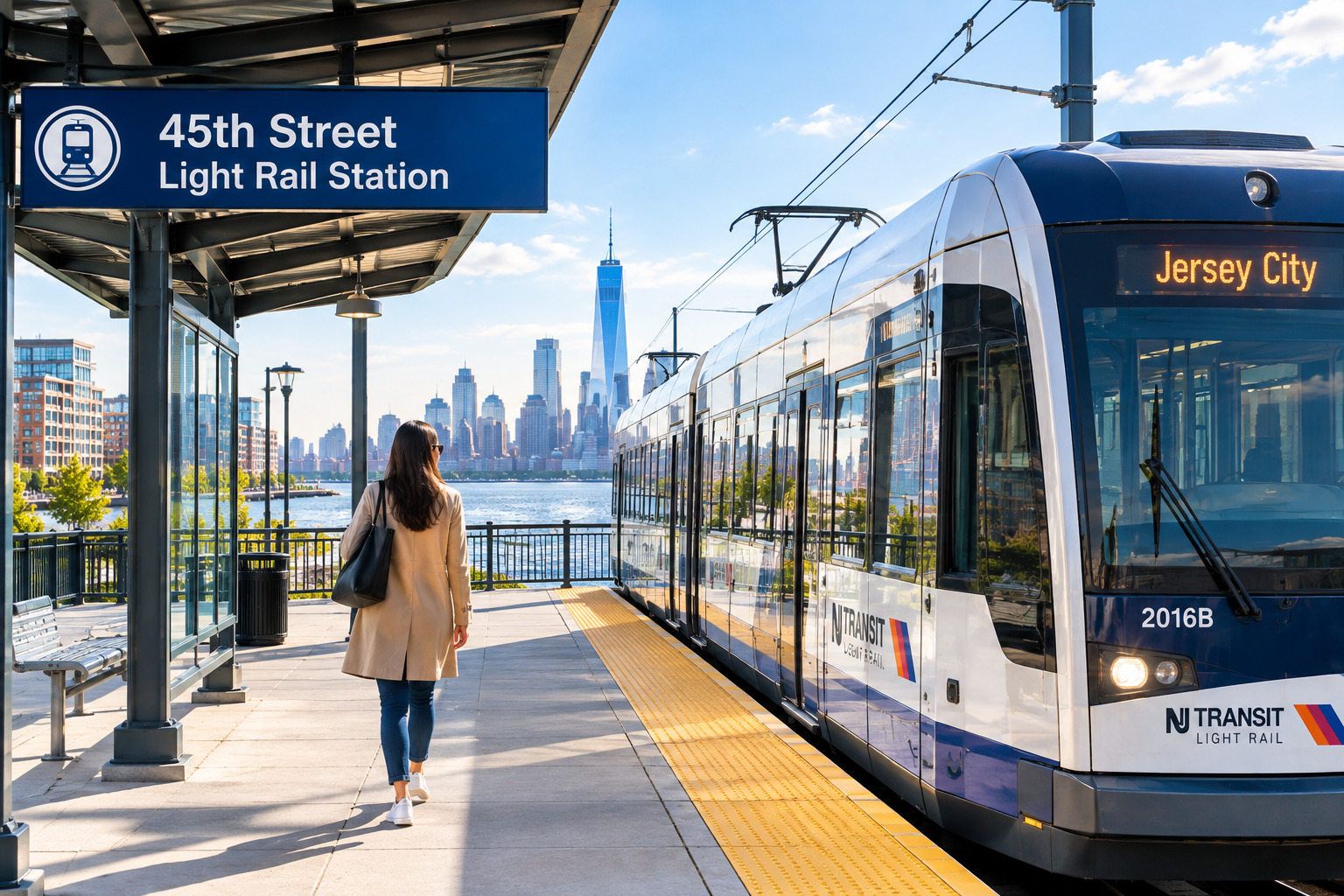
The Hudson Bergen Light Rail is particularly important because Bayonne is served by several stations along the line, including 8th Street, 22nd Street, 34th Street, and 45th Street. The line connects north through Jersey City and toward destinations including Exchange Place and Hoboken.
From there, commuters can connect with PATH services into Manhattan.
A second option is the NJ TRANSIT 119 bus, which provides direct service between Bayonne, Jersey City, and the Port Authority Bus Terminal in Midtown Manhattan.
The right choice depends largely on where your office is located, what time you travel, and whether you prefer a rail connection or a direct bus.
1. Hudson Bergen Light Rail
For many people commuting from Bayonne to NYC, the Hudson Bergen Light Rail is the most useful starting point.
The Bayonne portion of the line includes four stations:
- 8th Street
- 22nd Street
- 34th Street
- 45th Street
The line continues north through Jersey City, including stops such as Exchange Place, Harborside, and Newport, before reaching Hoboken Terminal.
The important point for Manhattan commuters is that the Light Rail itself does not take you into Manhattan. Instead, it can connect you with the PATH network at Exchange Place or other regional transportation points.
NJ TRANSIT currently lists the Hudson Bergen Light Rail base fare at $2.65. One way tickets are valid for 60 minutes, and the system operates on a proof of payment system. Riders need to purchase and validate their ticket before boarding when required.
Schedules change depending on the day and service conditions, so daily commuters should check the current NJ TRANSIT schedule before leaving rather than relying on an old timetable. NJ TRANSIT provides station to station schedules and trip planning through its official website and app.
Why renters may like the Light Rail
The Light Rail is useful when your commute begins close to one of Bayonne’s stations or when your destination is in Jersey City or along the Hudson waterfront.
For a Manhattan commute, think of it as the first part of a connected journey rather than the entire trip.
A typical journey could look like:
Bayonne residence → Hudson Bergen Light Rail → Exchange Place → PATH → World Trade Center → Manhattan destination
The exact travel time depends on your starting point, transfer timing, service conditions, and final destination.
2. PATH through Jersey City
For many Bayonne renters working in Manhattan, PATH is an important part of the commute. The main thing to know is that Bayonne does not have a direct PATH station, so you’ll need to reach a PATH station first before continuing into Manhattan.
The PATH system connects New Jersey with Manhattan, including World Trade Center and Midtown destinations through its network. Current PATH service includes the Journal Square, Hoboken, Newark, and World Trade Center corridors, with schedules varying between weekday, weekend, daytime, and overnight service.
For a Bayonne renter, the challenge is reaching a PATH station first.
This is where the combination of Bayonne’s Light Rail network and local transportation becomes important.
For example, a commuter can take the Hudson Bergen Light Rail toward Jersey City and connect with PATH at Exchange Place. Another option is to use a local or building shuttle to reach a PATH station and continue into Manhattan.
For Aqua residents, the building lists weekday shuttle service to Grove Street PATH Station as one of its commuting options. Aqua is located at 54 Flagship Street, and the nearby 45th Street Light Rail Station provides another option for getting around the area.
PATH also offers contactless TAPP payment, so riders can pay at the turnstile using a contactless credit or debit card or a compatible smart device. The PATH single-ride fare is currently $3.25.
For renters working near the World Trade Center, Financial District, or Lower Manhattan, a PATH based commute can be particularly relevant.
3. NJ TRANSIT Bus 119 to Manhattan
If your office is in Midtown, the NJ TRANSIT 119 bus deserves serious consideration.
The 119 route connects Bayonne with Jersey City, Hoboken, and New York’s Port Authority Bus Terminal. The route operates along JFK Boulevard through Bayonne before continuing toward New York.
That gives some commuters a major advantage: there is no need to make a separate PATH transfer to reach Midtown.
The route has multiple Bayonne stops, including locations along JFK Boulevard. Current NJ TRANSIT information shows the 119 operating between Bayonne and the Port Authority Bus Terminal, with additional connections through Jersey City and Hoboken.
For someone whose office is near Times Square, Midtown West, Hudson Yards, or the Port Authority area, reaching the city by bus can make practical sense.
The tradeoff is traffic.
Unlike rail, a bus is affected by road congestion, especially during the morning and evening rush. NJ TRANSIT schedules can also change because of construction or temporary road conditions. For example, current NJ TRANSIT advisories have included temporary stop changes for Route 119 in Hoboken.
For daily renters, the 119 is therefore worth considering as part of a flexible commute plan rather than assuming it will always take exactly the same amount of time.
4. Commuting from Bayonne to NYC by car
Driving is another option, particularly for renters whose work schedule does not match conventional office hours or who need a vehicle during the day.
The advantage is flexibility. You can leave when you need to, carry equipment or belongings more easily, and travel directly from Bayonne to your destination.
The disadvantage is predictability.
Traffic into and around New York can change significantly based on the time of day, weather, construction, incidents, and major events. Parking in Manhattan can also add another layer of cost and planning.
For someone commuting five days a week, it is worth comparing the complete cost of driving rather than only looking at fuel. Consider tolls, parking, vehicle maintenance, and the amount of time spent in traffic.
For many daily renters, public transportation can make more sense when the office is close to a reliable transit connection.
5. What about the ferry?
The waterfront location makes ferry transportation an important part of Bayonne’s future transportation story, but renters should distinguish between planned service and transportation that is currently operating.
Aqua’s neighborhood page describes an upcoming ferry and says its resident shuttle service is planned to provide access to the ferry.
That means renters should not build their current daily commute around ferry service until the route, landing, schedule, and operating details are officially confirmed.
NYC Ferry itself currently operates multiple routes across New York City, but its existing network should not be confused with a currently operating direct Bayonne to Manhattan service.
For now, Light Rail, PATH connections, and NJ TRANSIT bus service remain the practical transportation options to evaluate for a daily commute.
Choosing the right route based on your workplace
Your Manhattan destination matters almost as much as where you live.
– If you work in Lower Manhattan
Look closely at a Light Rail to PATH connection.
Reaching Exchange Place and transferring to PATH can provide a straightforward connection toward the World Trade Center area.
– If you work in Midtown
The NJ TRANSIT 119 can be particularly relevant because it connects Bayonne directly with the Port Authority Bus Terminal.
From there, you can continue to your workplace by subway, walking, or another local connection.
– If you work in Jersey City
You may not need to enter Manhattan at all.
The Hudson Bergen Light Rail provides connections to several Jersey City destinations, including Exchange Place, Newport, and other waterfront locations.
For hybrid workers, this can make Bayonne particularly practical because not every workday necessarily requires crossing the Hudson.
How Aqua fits into the daily commute
For renters, transportation is not only about the train or bus itself. It is also about the first and last part of the journey.
Aqua Bayonne is located at 54 Flagship Street on the Bayonne waterfront. The building currently offers a private resident shuttle service, and its neighborhood information highlights both the nearby 45th Street Light Rail Station and weekday shuttle service to Grove Street PATH Station.
That creates several potential ways to structure a workday.
You might walk or connect to the Light Rail, use the resident shuttle toward PATH, or choose NJ TRANSIT Bus 119 depending on your destination and schedule.
For residents who work hybrid schedules, this flexibility can also matter. Aqua has coworking space within the building, so not every workday has to involve a trip into Manhattan.
The result is a lifestyle where your commute can be treated as one part of the overall living experience rather than the only factor determining where you rent.
Tips for making your Bayonne to NYC commute easier
A good commute is usually less about finding one perfect route and more about having a reliable routine.
- Know two routes:- Have a primary route and a backup. If you normally take the Light Rail and PATH, know whether the 119 bus can work for your destination.
- Check service before leaving:- NJ TRANSIT and PATH publish current schedules, alerts, and service changes. This is especially important when track work, construction, or special events affect service.
- Choose your apartment location carefully:- The distance between your front door and your transportation connection matters every morning. A nearby station or reliable shuttle can make a noticeable difference over a five day workweek.
- Think about your actual office location:- A route that works well for a Financial District job may not be the same route you would choose for an office near Hudson Yards or Midtown.
- Give yourself transfer time:- A commute with one predictable transfer can often be easier to manage than constantly changing routes based on the fastest theoretical journey.
Is Bayonne practical for daily NYC renters?
The Bayonne to NYC commute is not a single route. It is a network of connections that gives renters several ways to reach Manhattan.
The Hudson Bergen Light Rail provides access toward Jersey City and key transit connections. PATH provides the direct New Jersey to Manhattan connection. NJ TRANSIT Bus 119 provides a direct Bayonne to Port Authority option. Driving offers flexibility for residents whose schedules require it.
For renters considering Bayonne, the most useful question is not simply how far the city is from New York.
It is how easily your particular home connects with your particular workplace.
For Aqua residents, the combination of the nearby Light Rail, private shuttle service, PATH access, and waterfront location adds another layer to that decision. The building offers studio apartments, one bedroom, and two bedroom residences alongside amenities designed for modern working lifestyles, including coworking space and on site transportation services.
If Manhattan is part of your weekly routine, understanding your commute before signing a lease can help you choose a home that works for both your workday and your life outside it.
Book a tour to see the residences and resident shuttle for yourself.
FAQs About the Bayonne to NYC Commute
Q1 – How do I commute from Bayonne to Manhattan?
Ans – Common options include the Hudson Bergen Light Rail with a PATH connection, the NJ TRANSIT 119 bus to the Port Authority Bus Terminal, or driving. The best route depends on your Manhattan destination.
Q2 – Is there a direct train from Bayonne to NYC?
Ans – There is no direct Bayonne to Manhattan train. The Hudson Bergen Light Rail connects Bayonne with Jersey City and other regional destinations, where commuters can connect to PATH for Manhattan.
Q3 – How much is the Bayonne to NYC commute?
Ans – The cost depends on the transportation combination you use. NJ TRANSIT currently lists the Hudson Bergen Light Rail base fare at $2.65, while PATH’s current single ride fare is $3.25. Bus fares vary by route and trip.
Q4 – Does Aqua Bayonne offer transportation for residents?
Ans – Yes. Aqua currently lists private resident shuttle service as an amenity, and its neighborhood page specifically highlights weekday shuttle service to Grove Street PATH Station.
Q5 – Is Bayonne a practical place to live if I work in NYC?
Ans – It can be, particularly for renters who choose a home with convenient access to Light Rail, PATH connections, or the 119 bus. Your office location and work schedule should determine which route makes the most sense.
Are you looking for a Bayonne apartment that keeps your NYC commute connected to the rest of your lifestyle?
Want to see how Aqua Bayonne’s waterfront residences and resident transportation options could fit your daily routine?